Which budgeting method fits your life?
Budgets rarely fail on day one; they fail in week six, when daily upkeep outgrows the life they were meant to fit. Choose a method by what it costs to run, not by what it promises.
By Pierre Teo · Updated
On this page
- Budgets fail at upkeep, not setup
- Pick by structure, priced in weekly upkeep
- 1. Awareness only: track, look, adjust
- 2. Pay yourself first: one automated rule
- 3. 50/30/20: guardrails for a paycheck
- 4. One daily number: the budget you can remember
- 5. Envelope budgeting: limits you see before you spend
- 6. Zero-based budgeting: every dollar gets a job
- Which method for which life stage?
- Every method runs on a spending record
- Frequently asked questions
- Which budgeting method is best for beginners?
- How much time does budgeting actually take?
- What should I do if I keep abandoning my budget?
- Do I need a mobile app to budget?
- Can I combine different budgeting methods?
Personal finance advice has a strange habit: its loudest proponents each insist their specific method is universal.
Ramsey Solutions calls zero-based budgeting its single recommendation "for everyone, at every Baby Step, in every situation" (Ramsey method guide). Meanwhile, retail banks hand every fresh graduate the 50/30/20 rule on a glossy brochure.
They cannot both be right. The two methods solve completely opposite problems.
The breakdown below covers what generic listicles skip: what each method actually costs in weekly maintenance, what it forces you to track every day, and which life situations it genuinely fits.
Budgets fail at upkeep, not setup#
Most people already try to budget, and most budgets quickly spring leaks.
In NerdWallet's nationwide study, 74% of Americans said they keep a monthly budget, 84% of budgeters admitted exceeding it, and of those who went over, 44% usually covered the overage with a credit card (NerdWallet, Harris Poll, 2023).
The pattern behind those numbers is maintenance fatigue.
Setting up a budget is an enjoyable Sunday afternoon with a spreadsheet or a shiny new app. Upkeep is an ordinary rainy Tuesday in month three when you're tired, you bought groceries, split a ride with friends, and just want to go to sleep.
You inevitably abandon a budgeting system whose maintenance demands exceed your daily energy long before you stop believing in the concept. YNAB, the most rigorous mainstream system, literally built a Fresh Start feature because falling off the wagon and resetting is a standard part of the user lifecycle.
The only metric that matters is which method you will still be running six months from now, not which one sounds most virtuous on day one.
Pick by structure, priced in weekly upkeep#
Placing yourself comes down to balancing two practical axes:
-
How much structure do you actually need?
- A guardrail keeps your broad spending roughly in shape while you live your life.
- Control accounts for every single dollar before the month even starts.
- Guardrails suit people who primarily need spending awareness; control suits tight margins, aggressive debt payoff, and people who find detailed accounting calming rather than draining.
-
How much upkeep will you realistically sustain?
- Judge your capacity by a busy week in month three, not by an ambitious week one.
- The time estimates below reflect our hands-on experience running and testing these systems; adjust for your own personal patience.
| Method | Weekly Upkeep | Structure | Best Fit |
|---|---|---|---|
| Awareness only | Seconds/day | None | Low stress, spending visibility |
| Pay yourself first | Near zero | Automated | Consistent savings goal |
| 50/30/20 | 5 min/mo | Guardrails | Broad paycheck structure |
| Daily number | Seconds/day | Pacing | Daily lifestyle spending |
| Envelopes | 2 min/wk | Category limits | Specific overspending categories |
| Zero-based | 30 min/wk | Total control | Debt payoff, tight budgets |
The six methods below run from lightest to heaviest. All six consume the exact same raw input: a record of what you spend, which is why building the recording habit always comes before choosing a method.
1. Awareness only: track, look, adjust#
The lightest method is no formal budget at all: log what you spend, glance at your running total, and let visibility do the behavioral heavy lifting. There are no categories to balance and no arbitrary targets to fail, so there is nothing to quit.
Paula Pant's anti-budget formalizes this philosophy: "Decide how much you want to save. Pull this off the top," and spend the remainder without tracking guilt (Afford Anything). Ramit Sethi's Conscious Spending Plan uses broad percentage ranges rather than rigid line items: fixed costs at 50% to 60% of take-home pay, roughly 10% to investments, 5% to 10% to savings, and 20% to 35% guilt-free spending (I Will Teach You To Be Rich).
- What you track: Each expense as it happens, nothing else.
- Weekly upkeep: Seconds per entry, a two-second glance a day.
- Who it fits: People whose spending is reasonably healthy and who want clear visibility; anyone recovering from an overly rigid system they abandoned.
- Who it doesn't fit: Extremely tight months or aggressive debt payoff, where awareness without hard limits merely documents the problem without stopping it.
2. Pay yourself first: one automated rule#
Transfer your savings target to a separate account the moment your paycheck lands, automatically, before any everyday spending occurs.
Popularized a century ago by George Clason in The Richest Man in Babylon (1926), this remains the lowest-effort system that still guarantees a financial result: because the saving already happened on day one, the rest of the month can only threaten what is left over.
- What you track: Strictly speaking, nothing, though an expense log tells you whether your day-to-day spending is drifting.
- Weekly upkeep: Near zero once your automated bank transfer is scheduled.
- Who it fits: Steady salary earners whose primary goal is hitting a consistent savings rate.
- Who it doesn't fit: Anyone struggling with impulsive spending within the remaining balance, or people with highly variable income lacking a cash cushion.
3. 50/30/20: guardrails for a paycheck#
Allocate 50% of after-tax income to needs, 30% to wants, and 20% to savings and debt repayment.
Elizabeth Warren and Amelia Warren Tyagi introduced this framework as the "Balanced Money Formula" in their 2005 book All Your Worth. It became the default starter budget recommended by banks and financial literacy courses for one key reason: three buckets are learnable in two minutes and reviewable in five.
The primary limitation is the 50% needs cap in high-cost-of-living cities. Even Dave Ramsey, arguing for zero-based budgeting, notes: "the math doesn't work for most Americans" when housing and utilities alone consume over half of take-home pay (Ramsey critique). If your fixed overhead exceeds 50%, treat the ratios as a general target rather than a pass-fail exam, or use adjusted splits like 60/30/10.
- What you track: Each expense tagged under Needs, Wants, or Savings; a monthly check on three totals.
- Weekly upkeep: Seconds per entry plus a 5-minute monthly review.
- Who it fits: First-time budgeters, new graduates, and anyone wanting structure without micro-management.
- Who it doesn't fit: Tight budgets requiring strict category caps; high-rent urban areas unless percentages are adjusted.
4. One daily number: the budget you can remember#
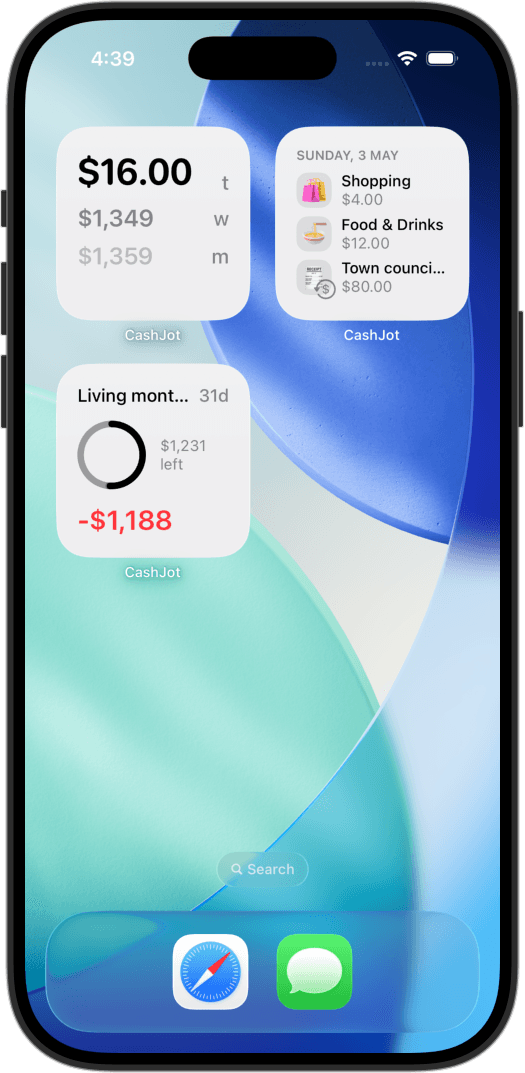
Take what you have available to spend this month after all fixed bills and savings, divide that number by the days in the month, and pace yourself against that single daily figure.
Some days you spend under your number; other days you spend over. But you are guided by a number small enough to hold in your head while ordering lunch. This is the mental model that consistently survives real life: one number, checked at a glance on your home screen, with zero reconciliation debt when you miss a day.
- What you track: Each daily purchase; today's running total against your daily target.
- Weekly upkeep: Seconds a day.
- Who it fits: People struggling with daily lifestyle leak (takeout, coffee, impulse online buys); anyone wanting immediate pacing feedback.
- Who it doesn't fit: Months dominated by large, irregular expenses that distort a simple daily average.
5. Envelope budgeting: limits you see before you spend#
The classic envelope system divides physical cash into labeled paper envelopes for each category (Groceries, Dining Out, Entertainment). When an envelope is empty, spending in that category stops for the month.
The psychological power is in the timing: the spending limit confronts you before the transaction at the register, not three weeks later on a credit card PDF. TikTok rebranded this as "cash stuffing", but the core mechanism is unchanged.
Physical cash, however, is increasingly impractical. Subscriptions and digital bills cannot live in an envelope, and in card-first economies, carrying cash notes creates unnecessary friction. In Singapore, for instance, cash has dropped to just 13% of in-store spending (Worldpay Global Payments Report).
The modern digital adaptation keeps the psychological boundary while dropping the paper notes: per-category limits tracked over a live spending record. When a category runs dry, you make an explicit decision: stop spending, consciously move funds from another category on your ledger, or intentionally overspend and let the record reflect it.
Dedicated tools cater to digital envelopes:
-
Goodbudget offers a free tier with 10 regular and 10 annual/goal envelopes on one account (Premium is $10/month or $80/year).
-
Actual Budget is a free, open-source envelope system you can self-host.
-
A custom spreadsheet works too, provided you enter transactions consistently.
-
What you track: Each expense tagged to its category, checked against the remaining limit.
-
Weekly upkeep: A few seconds per entry plus a quick weekly glance at remaining balances.
-
Who it fits: People who routinely overspend in two or three specific problem categories; visual thinkers who ask "how much is left for dining out?"
-
Who it doesn't fit: Unpredictable months where category limits require constant mid-week adjustments; people who find detailed categorizing tedious.
6. Zero-based budgeting: every dollar gets a job#
Zero-based budgeting assigns 100% of your incoming income to specific jobs before the month starts: Income minus Outflow (bills, spending, savings) equals Zero.
Peter Pyhrr created the framework at Texas Instruments, publishing it in the Harvard Business Review in 1970 as a corporate management tool. Personal finance adopted the name decades later. Its two prominent commercial apps are YNAB ($14.99/month or $109/year with a 34-day trial) and Ramsey's EveryDollar (free manual tier; Premium is $17.99/month or $79.99/year).
This represents the maximum-control end of the spectrum. When money is tight or you are aggressively eliminating debt, nothing provides greater clarity over where every cent went.
The tradeoff is the highest upkeep of any method: you must allocate income before the month, manually adjust categories whenever real life deviates from the plan, and reconcile bank accounts regularly. Skip a week, and reconciliation debt piles up quickly, the exact friction that prompts users to hit YNAB's Fresh Start button. Furthermore, mainstream apps rely on bank feeds covering select US, Canadian, UK, and European institutions; outside those regions, users pay full subscription prices for what is effectively manual entry.
- What you track: Every single transaction, categorized and reconciled against planned allocations.
- Weekly upkeep: A dedicated 20–45 minute weekly review session plus consistent daily entry.
- Who it fits: Tight financial margins, aggressive debt payoff, detail-oriented planners, and couples needing a single shared financial source of truth.
- Who it doesn't fit: Anyone looking for passive tracking; people with low tolerance for administrative upkeep who will lapse and feel unnecessary guilt.
Which method for which life stage?#
Review sites typically rank methods by software features. Your real-world life situation is a far more reliable guide:
- Students and first jobbers: Start with a guardrail: 50/30/20 for big-picture shape, or one daily number if your main challenge is daily lifestyle spending. Upgrading to heavier structure later is easy; abandoning an overly complex first budget often discourages people from tracking altogether.
- Irregular income and freelancers: In a 2026 Experian survey, over 80% of gig workers reported unpredictable income, and nearly 3 in 4 experienced income swings of 25% or more (Experian gig worker survey). Set your baseline budget against a historically low month and buffer surplus income in strong months. Percentage guardrails flex naturally with fluctuating income, whereas zero-based plans require re-allocating every time cash arrives.
- Couples and shared households: The method matters less than keeping the process painless for both partners. Choose the lightest system both people will consistently maintain. Category limits work well for the specific shared discretionary areas (like dining or home goods) that couples most often debate.
- Outside US banking systems: Most popular method guides assume seamless automated bank sync. In regions where bank sync is unsupported, automated apps turn into expensive manual tools. Choosing methods that rely on minimal infrastructure (guardrails, a daily number, or lightweight category limits over a local record) works far more reliably worldwide.
Every method runs on a spending record#
Strip all six methods down to their essential machinery, and they all depend on the exact same foundation: an accurate record of what you spend.
- The anti-budget needs a record to ensure your leftover spending isn't secretly outpacing income.
- 50/30/20 needs entries tagged to three core buckets.
- Digital envelopes and zero-based budgeting need entries organized by category.
- Even pay-yourself-first needs a record when the leftover cash runs short before payday.
That makes establishing your recording habit the true first step, well before deciding on a formal budget methodology. How you capture spending on your phone and where that record lives determines whether your financial habit survives.
Starting with simple awareness also gives you genuine baseline data: tracking for just two weeks reveals whether your spending leak is a specific category, a daily takeout habit, or nothing to worry about.
CashJot is built specifically for that record-first approach: daily logging is free, Apple Pay purchases can be captured automatically on-device without linking your bank credentials, and when you are ready for structured boundaries, CashJot Plus adds budgets scoped to individual categories on monthly, weekly, or custom schedules.
Start with the record, track your purchases for two weeks, and then adopt the lightest method that solves what your numbers reveal.
Frequently asked questions#
Which budgeting method is best for beginners?#
A lightweight guardrail system: either the 50/30/20 rule if you want a broad framework for your paycheck, or one daily spending number if your primary challenge is day-to-day purchases. Both are understandable in minutes, take almost zero daily maintenance, and are easy to build upon later.
How much time does budgeting actually take?#
It varies dramatically by method. Simple awareness tracking and daily-number pacing take under thirty seconds a day. The 50/30/20 rule adds a five-minute monthly review. Envelope tracking adds a quick weekly glance at category limits. Zero-based budgeting requires a focused 20 to 45-minute weekly session plus disciplined categorization. Pick the time commitment you will realistically sustain in month three.
What should I do if I keep abandoning my budget?#
Step down to a lighter method rather than forcing yourself to try harder. A lapsed zero-based budgeter usually thrives with a daily number or basic envelope limits. Keep the only habit that truly matters (logging your daily spending) and restart from today rather than trying to backfill missed weeks.
Do I need a mobile app to budget?#
No. Every budgeting methodology predates smartphones: 50/30/20 came from a book, envelope budgeting used paper envelopes, and zero-based budgeting originated in 1970s corporate planning. An app adds speed and convenience; see our guide on choosing between spreadsheets, Notion, and apps.
Can I combine different budgeting methods?#
Yes, and combining them often works better than sticking rigidly to one. You can automate savings on payday (pay yourself first), pace daily discretionary spending with a daily number, and place envelope limits on the two specific categories where you tend to overspend. Every working combination runs smoothly on a single, consistent spending record.
Written by Pierre Teo, maker of CashJot.
Track daily spending without the chore
2-second keypad logging, automatic Apple Pay capture, and live home screen widgets. Free, private, and 100% offline.