Cash or card in Southeast Asia? Plan for more cash than you expect
Locals across Southeast Asia pay by QR code, but the QR rails mostly run on domestic bank accounts. Visitors end up paying far more in cash than headlines suggest, and the trick is planning for it without losing track of it.
By Pierre Teo · Published
On this page
- Tourists pay cash even where locals don't
- How much cash each country still runs on
- The fee traps when you do pay by card
- 1. Foreign transaction fees (your bank's fee)
- 2. Dynamic Currency Conversion (the terminal's rip-off)
- A withdraw-and-track system that ends with a number
- 1. Count it once
- 2. Fix one rate for the trip
- 3. Log at the moment money changes form
- Frequently asked questions
- Should I use cash or card in Thailand?
- Should I use cash or card in Vietnam?
- How much cash should I bring on a trip?
- Is Dynamic Currency Conversion (DCC) ever worth accepting?
- Do I need a multi-currency travel card for Southeast Asia?
Travellers heading into Southeast Asia tend to make one of two opposite mistakes.
Some land with cards only, then discover that the night market, the songthaew or tuk-tuk, and the best noodle stalls take nothing but physical notes. Others panic-change far too much cash at airport counters, eat hefty exchange spreads on the way in, and fly home with a wallet full of leftover currency.
The middle path is much calmer: carry real cash, pay by card where cards are genuinely welcome, dodge the one expensive rip-off at the terminal, and log what you spend so the trip ends with a clean number rather than a mystery.
Tourists pay cash even where locals don't#
Thailand publishes the clearest picture of how visitors actually pay.
A whitepaper by the Bank of Thailand and Visa found that cash still accounted for 78% of international tourists' transaction value in 2024 (The Nation's coverage), even as card spending by tourists reached a record 327 billion baht, about 20% of the total (Visa Thailand press release). Cross-border QR payments (the feature that would let a foreign digital wallet scan a local merchant code) made up just 0.2% of tourist spending (whitepaper coverage).
Meanwhile, Thai locals run daily life almost entirely on PromptPay QR codes.
That is the paradox across Southeast Asia: the payment rails that made the region feel wonderfully cashless are domestic networks. PromptPay in Thailand, QRIS in Indonesia, and DuitNow in Malaysia are built around local bank accounts and local identity numbers. Cross-border links (such as Singapore's PayNow bilateral connections) are expanding, but acceptance remains far too patchy to rely on for a holiday budget.
At street level, a visitor's trip looks closer to traditional travel than fintech marketing suggests: cards work smoothly at hotels, shopping malls, and grab rides; physical cash carries the street food, night markets, small family restaurants, taxis in regional towns, and temple entrance fees.
How much cash each country still runs on#
The Worldpay Global Payments Report measures how much in-store spending happens in cash across different economies. The 2024 figures for the region (Worldpay GPR 2025, PDF):
| Country | Cash share of in-store transaction value, 2024 |
|---|---|
| Singapore | 13% |
| Malaysia | 23% |
| Thailand | 31% |
| Vietnam | 35% |
| Indonesia | 38% |
| Philippines | 41% |
The Philippines carries the highest cash share in Southeast Asia.
Keep in mind that these numbers represent whole-economy data, heavily dominated by local residents. As the Thai central bank data proves, international visitors skew far more cash-dependent than national averages because tourists lack access to domestic QR rails.
The contrasts across Asia put these numbers in perspective. Singapore is an extreme outlier at 13% cash and falling (Worldpay projects 8% by 2030), which is why travellers from Singapore are often the most surprised by how much cash a trip through Vietnam or the Philippines requires.
Japan, a frequent companion stop on regional itineraries, sits at the other end: its Ministry of Economy, Trade and Industry (METI) reported cashless payments at 42.8% of consumer spending in 2024 (METI press release), meaning a majority of consumer transactions still happen in cash. Finding a 7-Eleven ATM remains a regular part of any Japan trip.
The fee traps when you do pay by card#
Card acceptance is not the same as card value. When you tap a card abroad, your bank's markup and the terminal's conversion offer both try to take a cut. Only one of them is avoidable.
1. Foreign transaction fees (your bank's fee)#
This is your home bank's fee for processing a charge in another currency. On US credit cards, the typical range is 1% to 3%, though no-foreign-transaction-fee travel cards are widely available (NerdWallet's card roundup).
Singapore banks charge more across the board: DBS, for instance, charges approximately 3.25% on foreign-currency card transactions (DBS fee schedule), with OCBC at a similar level (OCBC card fees, PDF). Multi-currency debit cards like YouTrip, Wise, and Revolut exist primarily to eliminate this markup. Check each provider's own pricing page directly for their exact ATM and conversion terms.
2. Dynamic Currency Conversion (the terminal's rip-off)#
Dynamic Currency Conversion (DCC) happens when a payment terminal or ATM asks if you would prefer to be charged in your home currency (e.g., "Pay in USD/SGD instead of THB/VND").
Decline this every single time.
A peer-reviewed study on DCC pricing found the average merchant terminal markup was 7.6% above the card network exchange rate, with observed markups climbing as high as 12.4% (Gerritsen, Lancee and Rigtering, 2023).
Always select the local currency on the screen. Your own bank's standard exchange rate, even with its normal fee, is substantially cheaper. Our guide to multi-currency expense tracking explains why your statement total will still differ slightly from the menu price.
The same rule applies at overseas ATMs: withdraw in the local currency and decline any on-screen currency conversion offer. Making fewer, larger withdrawals beats making frequent small ones, since local ATM operator fees are charged per transaction.
A withdraw-and-track system that ends with a number#
Cash is where holiday budgets go dark: card spending leaves a digital paper trail, but paper notes simply vanish from your wallet. Three simple rules keep your cash visible:
1. Count it once#
Either the ATM withdrawal is the expense, or the individual purchases are, never both. On the road, the simple version wins: log each ATM withdrawal or money exchange as a single entry in the local currency, then spend the cash notes freely without logging every fruit smoothie or train token. Our cash tracking guide walks through both approaches.
2. Fix one rate for the trip#
Pick a clean exchange rate on departure day and use it for every entry instead of chasing daily currency wiggles. Pacing a vacation budget needs a consistent baseline, not four-decimal forex precision. Our multi-currency tracking guide shows how to choose a practical rate.
3. Log at the moment money changes form#
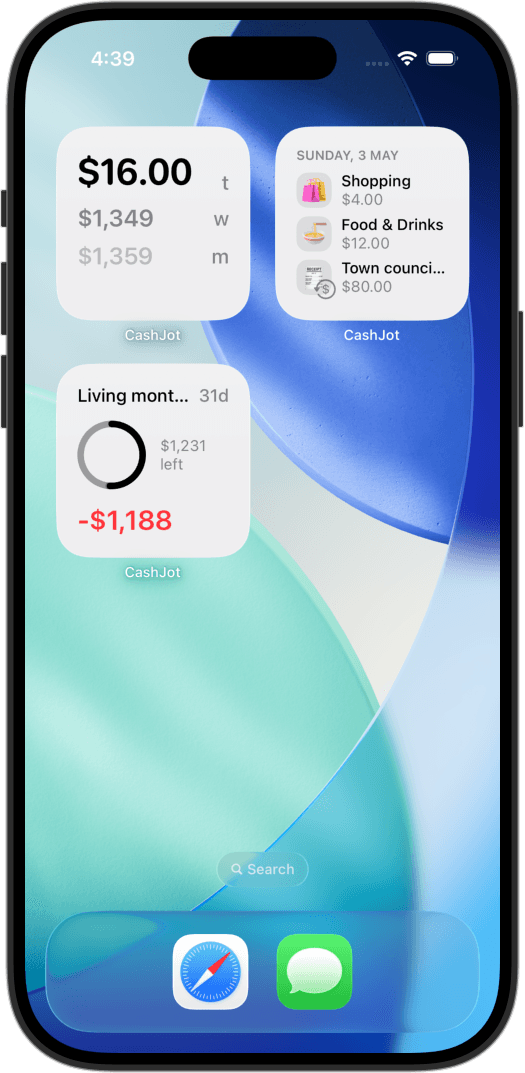
The ATM withdrawal, the money changer, the card tap: each is a two-second entry. In CashJot, create a dedicated trip Expense Group with the local currency set at your fixed rate. Logging takes two seconds, Apple Pay taps can capture themselves on-device, and everything works fully offline, which matters most in the rural or market areas where cash is king.
When you track this way, the end of the trip looks very different. A Visa US travel survey found that travellers returned home with an average of US$40 in unspent foreign currency, and 24% admitted buying items they didn't even want just to burn off leftover cash (Visa travel study, 2023).
A tracked trip ends on purpose: you know what you spent, you know what is left, and any leftover bank notes are simply a clean line in your ledger.
Frequently asked questions#
Should I use cash or card in Thailand?#
Use both, deliberately. Credit and debit cards work smoothly at hotels, shopping malls, supermarkets, and chain restaurants. Cash is essential for night markets, street food stalls, taxis, tuk-tuks, and small local shops. Because Bank of Thailand and Visa data shows international tourists still spend 78% of their money in cash, plan ATM withdrawals as a routine part of your trip rather than an emergency.
Should I use cash or card in Vietnam?#
Plan for even more cash than in Thailand. Cash accounted for 35% of all in-store retail spending in Vietnam in 2024, locals included, and tourist-facing small vendors are almost exclusively cash-based. Reliable card acceptance is concentrated in larger hotels, convenience stores, and upscale restaurants in major cities like Hanoi and Ho Chi Minh City.
How much cash should I bring on a trip?#
There is no universal dollar figure, and you should be cautious of any article that claims one. Calculate your estimate directly: estimate your daily out-of-pocket spend for meals, transit, and small purchases, multiply by the days on the ground, and subtract anything already paid for by card (like hotels or booked excursions). Withdraw cash in one or two larger batches to minimize per-transaction ATM fees, and log each withdrawal once.
Is Dynamic Currency Conversion (DCC) ever worth accepting?#
No. Paying in your home currency at a foreign card terminal or ATM hands the conversion rate to the merchant's local bank, adding an average markup of 7.6% according to peer-reviewed data. Always choose to be charged in the local currency and let your own bank or card network handle the exchange.
Do I need a multi-currency travel card for Southeast Asia?#
It helps eliminate card fees, but it does not replace cash. Multi-currency cards like YouTrip, Wise, or Revolut save you from the 1% to 3.25% foreign transaction fees charged by traditional banks on card purchases, but they cannot bypass the cash-only reality of local street markets. Whatever card you carry, stick to the simple system: one trip Expense Group, one fixed rate, and count cash once.
Written by Pierre Teo, maker of CashJot.
Track daily spending without the chore
2-second keypad logging, automatic Apple Pay capture, and live home screen widgets. Free, private, and 100% offline.